Current Work
Structure–Activity Relationships in Bioactive Coordination Compounds
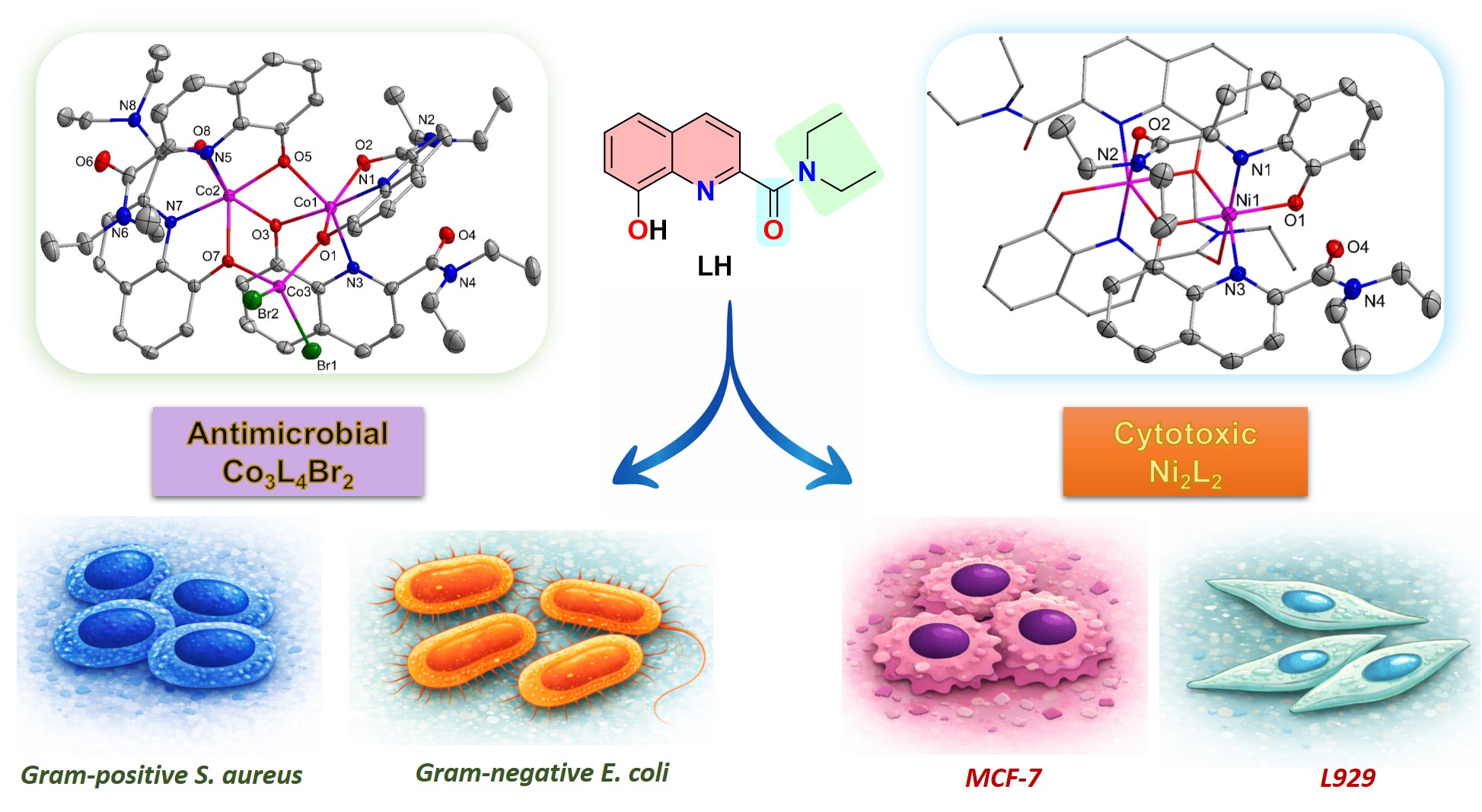
A parallel direction in the group uses structurally defined metal complexes to relate coordination environment to biological response. Rather than treating activity as a screening result alone, we examine how metal identity, nuclearity, donor set, halide coordination, and molecular compactness influence antimicrobial, antifungal, antibiofilm, and cytotoxic behavior.
Recent quinoline-derived systems illustrate this structure–activity logic, where related ligand scaffolds can produce distinct biological outcomes depending on metal identity and coordination architecture. This work now guides antifungal and antibiofilm studies with copper and related coordination compounds.
Key questions
- How does metal identity redirect the same ligand scaffold toward antimicrobial, antifungal, or cytotoxic behavior?
- Which roles do nuclearity, halides, geometry, and compactness play in biological response?
- Can crystallography, MIC data, zone inhibition, cell viability, and microscopy be combined into a clear structure–activity model?